Phi Matrices: Why the Golden Ratio Isn't Beauty, It's Language. By Lady Krystyna Vinogorodska
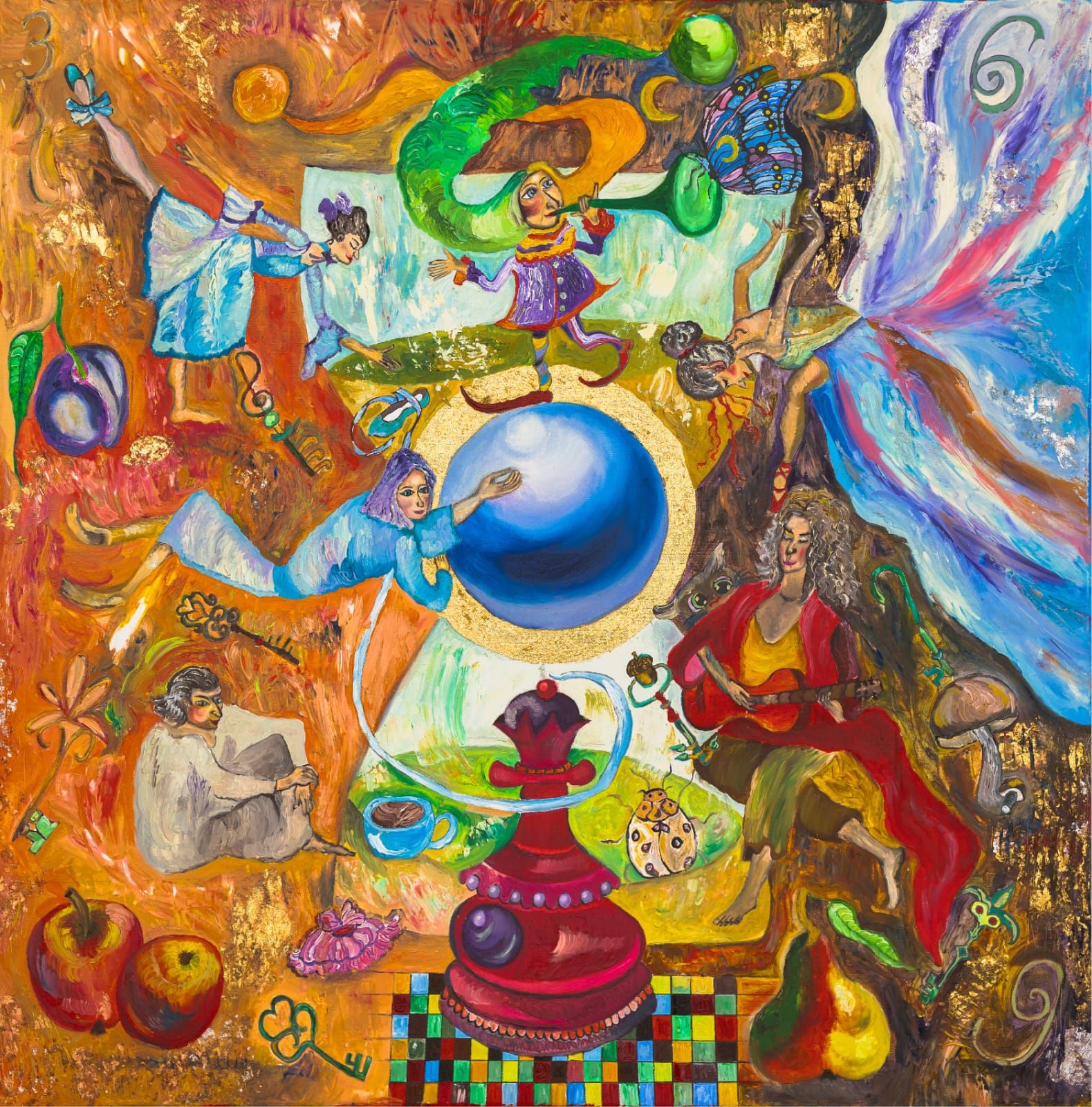
The number that is everywhere
There is a number you don't need to look for. It finds you.
In the spiral of a snail. In the arrangement of sunflower seeds. In the proportions of the human hand—from fingertip to wrist, from wrist to elbow. In the ratio of white and black keys per octave on a piano. In the architecture of the Parthenon and in the structure of DNA.
This number is Φ. Phi. 1.6180339…
It's called the golden ratio. But this name is a bit misleading—it sounds like an aesthetic category, something to do with taste. As if "beautiful" means "golden."
In fact, everything is more precise and interesting. Φ is the principle of growth of living systems. The principle by which nature organizes complexity without losing stability.
And that's why it turned out to be the key to understanding how we perceive - and how we feel.What is the Phi Matrix?
The Phi Matrix isn't just a compositional grid that artists lay on the canvas like a template. It's something fundamentally different.
The classic grid divides space mechanically: into equal parts, into thirds, into squares. It's convenient, but neutral—it doesn't convey any dynamism.
The Phi matrix is constructed differently. It is created by successively dividing space in a ratio of 1:1.618—so that each subsequent level of division contains a proportion of the previous one. It is a recursive structure: it is self-similar at any scale.
Imagine a spiral unfolding from within, each turn maintaining a precise relationship with the previous one. This is the logic of the Phi matrix in space.
When such a grid is superimposed on an image, it doesn't simply divide it. It reveals tensions: points where form "sounds" most powerfully, axes along which attention moves, zones where space "breathes," and zones where it "holds." Why does the brain sense this?
This is where neuropsychology comes in.
Neuroaesthetic research shows that when a person looks at an image constructed using the golden ratio, areas of the brain associated not only with visual perception but also with anticipation and reward are activated. In other words, the brain literally "expects" more—and receives it. This creates a sense of completeness, which we call harmony.
But more importantly, the same neural response occurs in response to living biological structures—the branching of a tree, the shape of a wave, a human face with its symmetrical but imperfect features. Because they are all organized according to a similar principle.
The brain didn't learn to calculate Φ. It's evolutionarily tuned to recognize this pattern—because in nature, it marks what's alive, healthy, and stable.
This means that when we look at a picture constructed using the Phi Matrix, we don't just see a "beautiful composition." We receive a signal on a very deep level: there is life here. There is an order here that can be trusted. The Phi Matrix and Emotional State
Now comes the most important thing for the “Architectonics of Emotions”.
If the Phi matrix reveals tensions in the image space, it can also reveal tensions in the artist's emotional space.
In my practice, I've discovered the following: when I apply the Phi matrix to an existing work—not beforehand, as a diagram, but afterward, as an analytical tool—it reveals where exactly the painting's emotional energy is concentrated. Where there was fear, there's
