The Architectonics of Emotions: Why is it Necessary?
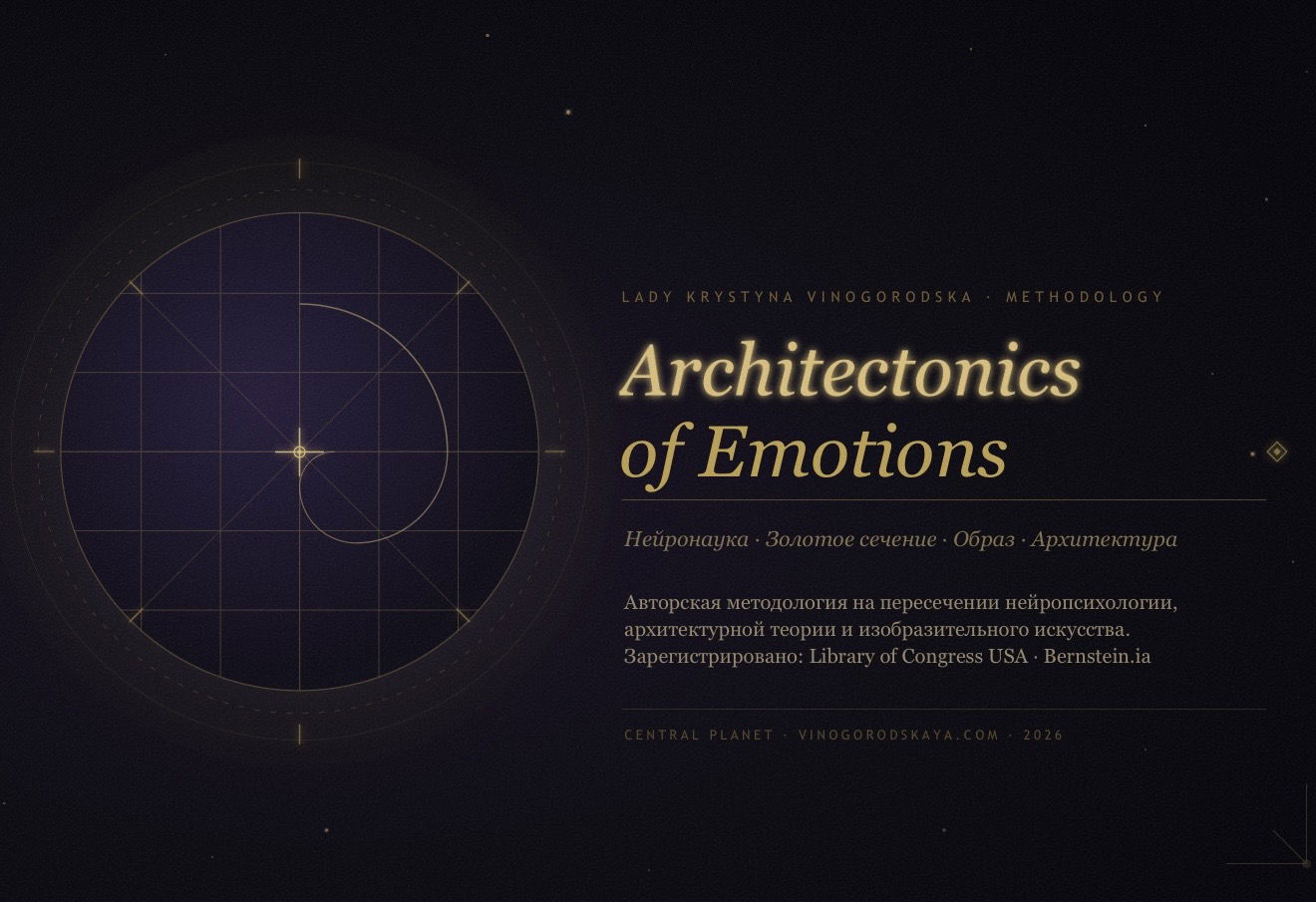
Lady Krystyna Vinogorodska's proprietary methodology at the intersection of neuroscience, psychology, and art. Imagine you live in a huge house. You know the kitchen and the bedroom. Sometimes you wander into the hallway. But most of the rooms are locked. You don't know what's there. Sometimes sounds come from within: a rumble of alarm, unexpected laughter, a wave of inexplicable sadness. You react—but you don't understand where it's coming from. And you certainly don't know how to get inside and change anything.
This is how most people exist in their emotional world.
The architectonics of emotions is the first blueprint of this house, executed in both the language of science and the language of imagery. Why emotions seem like chaos
We use the word "emotion" every day. But few people ask themselves: what exactly happens inside us when we feel something? Not in the sense of "I'm upset" or "I'm in love"—but in the sense of the mechanism, the architecture, the internal logic of this event.
Neuroscience has long established that emotions are not random outbursts or weaknesses of character. They are complex structures that link the body, memory, perception, and meaning. They operate faster than thought because they evolved earlier. They shape our decisions long before we even have time to "accept" them. Neuroscientist Antonio Damasio has shown that people with damaged emotional centers of the brain lose the ability to make even the simplest choices—not because they've become dumber, but because they've lost their emotional compass.
Emotions are no obstacle to reason. They are its first and most ancient language.
But we weren't taught this language. We were taught to suppress it, ignore it, "pull ourselves together." As a result, most people perceive their inner state as something dark and uncontrollable—something that happens to them, not something they can navigate. This leads to chronic anxiety, impulsive decisions, creative blocks, the feeling that you're not living your life, but you don't understand why.
There's a reason for this. And there's a solution. What is the Architectonics of Emotions?
The architectonics of emotion is a proprietary research methodology registered with the Library of Congress (USA) and Bernstein (Germany). It is not a psychotherapeutic method, nor a variation on the typologies of Jung, Pearson, or Markova. It is a distinct discipline that emerged at the intersection of neuropsychology, architectural theory, and the visual arts.
It is based on an idea that seems simple, but changes everything: the human emotional world is structured like an architectural space.
It contains supporting structures and decorative elements. Halls where joy dwells, and basements where old fears are hidden. Windows through which the light of creativity shines, and blank walls where pain once occurred. Symmetry and the deliberate violation of symmetry. Proportions by which one state flows into another.
And—as in any architecture—it's precisely understanding the structure that allows us to change the space. Not by destroying it, but by consciously rebuilding it. The four pillars of the methodology
The architectonics of emotion rests on four foundations, each of which constitutes a distinct scientific or artistic tradition. Together, they create something that none of them possesses individually.
Neuropsychology of emotions. This methodology draws on modern data on the functioning of the limbic system, the role of interoception—the body's ability to sense itself from within—an
