Fibonacci Psychology: How the Soul Grows.
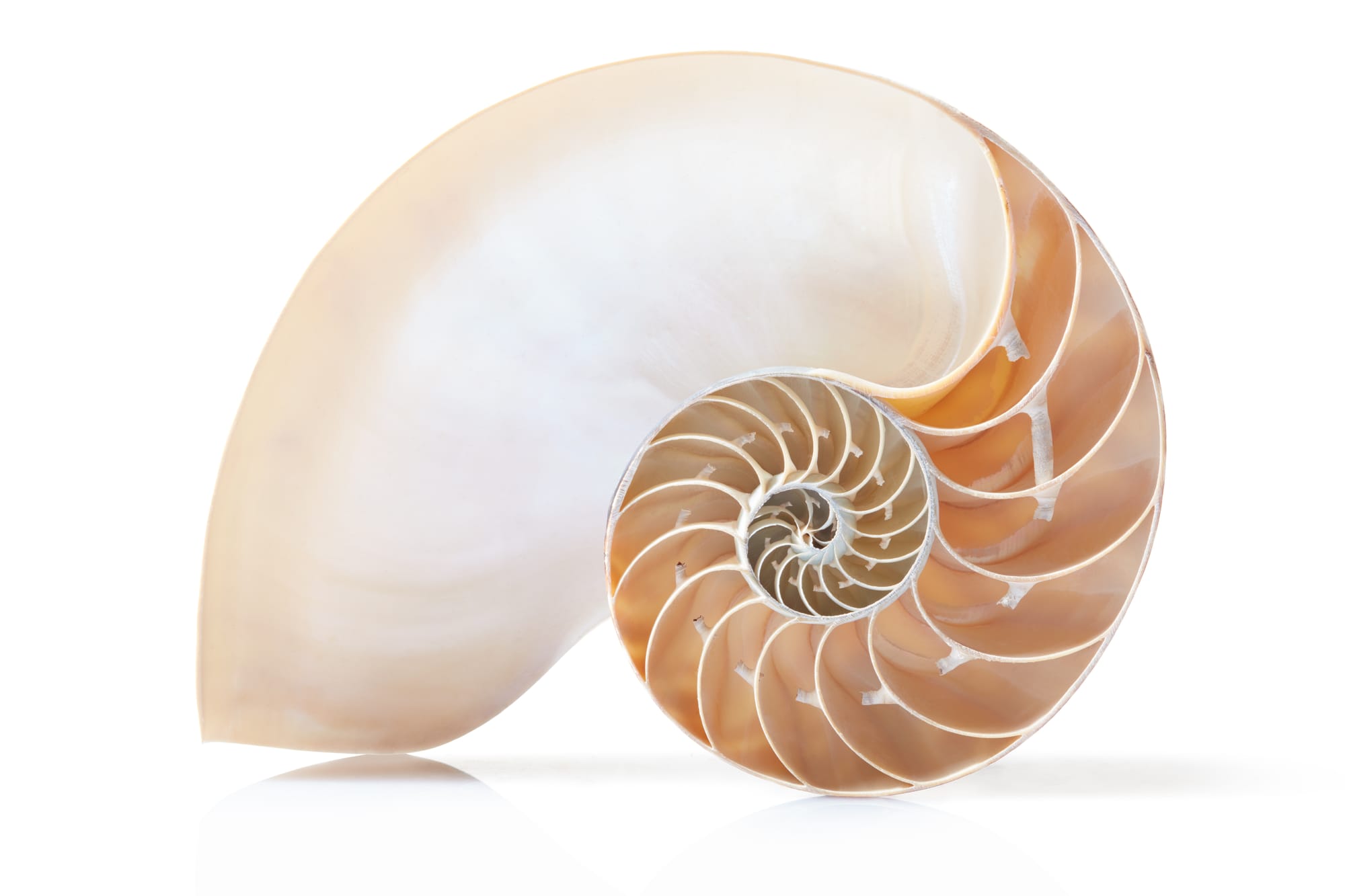
"Everything that has a form lives by the law of the golden spiral. Even if it doesn't realize it."There is no ruler in nature. All living things grow not in a straight line, but according to the law of rhythm. A snail, a pine cone, a galaxy, a curl of a child's hair - all repeat the same shape: the Fibonacci spiral.
And humans are no exception. We think that we develop progressively. That if we try, tomorrow will be a little better than today. But real growth psychology is not linear. It is spiral.
1. Cyclicity of pain and return
Every step forward is also a return. You feel the same anxiety, the same melancholy, the same loss again. But not with the same body. Not with the same maturity. A new turn - similar, but wider.The psyche moves like a mollusk shell: always in a circle, but ever further from the center. We return to the same states - not because nothing changes, but because the spiral makes a turn.
2. The Golden Ratio of Experience
There is a balance point within each of our decisions. Not a perfect middle ground, but a golden ratio – when intuition and logic are balanced, when you don’t rush forward out of fear, and don’t cling to the past out of pain.This is the moment of “getting into yourself”. It is not measurable by logic. But it can be felt by the body. As if everything fell into place. A micro-moment of internal symmetry.
3. Why it is important to stop
The Fibonacci spiral does not grow continuously. Between each new ring there is a pause, silence, a quieting down. Psychology knows this: the integration phase. After changes there must be a stop. Not every growth is an upswing. Sometimes growth is a slowdown.He who is in a hurry to "become better" often goes against the rhythm of his own soul. Nature does not tolerate violence against form.
4. Harmony as mental health
True harmony is not “everything is fine.” True harmony is when you live in harmony with the inner spiral: knowing that after expansion comes contraction, after inspiration comes fatigue, after a meeting comes emptiness. But all this is within one form. One you.Fibonacci is not about math. It is about trusting the process. About how even pain is part of the correct form. Even chaos is part of the pattern.
P.S.
If you feel that you have once again returned to an old topic, to an old pain - do not rush to consider this a rollback. Perhaps this is just a new turn of the spiral. Already closer to the light.5. Identity as its own spiral
In the 21st century, identity is a word-ellipsis. People look for themselves in genes, in careers, in gender, in diagnoses, in brands. But what if identity is not a form, but a movement?Everyone has their own spiral. Some grow through loss. Some through loneliness. Some through beauty. Everyone carries their own Fibonacci formula, and the way they grow, the way they return to themselves, cannot be compared.
We are used to looking for identity as an answer - "Who am I?" But from the point of view of Fibonacci psychology, identity is not an answer, but a pattern of returns. Repeating questions that sound deeper with each turn: - Why is this important to me? - Where does this come from in me? - What do I leave unchanged in any version of myself?
A mentally mature person is not someone who knows everything about themselves, but someone who has learned their rhythm. Someone who is not afraid to return. Someone who feels: “It’s me again. But already different. And still me.”
Comments
